This opera does not represent metamorphosis; it performs it. It grows, swells, condenses, ruptures, and radiates with the logic of something alive.
Some works do not simply appear within the landscape of contemporary performance – they recalibrate the very mechanics through which the stage perceives itself. These are not pieces that appeal to emotion or narrative allegiance; instead, they alter the sensorium, drawing the audience into a realm where sound behaves like a living organism, time thickens into a tactile substance, and the line between human presence and environment dissolves into a shared metabolic continuum. Tiko Gogoberidze’s Cactus, unveiled on 22–23 November 2025 at Tbilisi’s Haraki Theater, is unmistakably such a creation.
This opera does not represent metamorphosis; it performs it. It grows, swells, condenses, ruptures, and radiates with the logic of something alive. It opens like a cross-section of earth and contracts like a lung. Over forty uninterrupted minutes of continual transformation, the work maps a consciousness caught between the accelerated rhythms of modern life and the slow, patient temporality of a plant that simply endures.
The Stage as an Engine of Duration
The production constructs not a set but a system – a space that feels engineered rather than decorated. The chamber resembles an elevator: a suspended cube oscillating between mechanical realism and metaphysical implication. Designer Mariam Songhulashvili creates an interior where surfaces operate like membranes, not walls; light glides across them with the precision of laboratory optics.

Achi Arghanashvili’s lighting shapes time into a visible material – thin folds of illumination, sudden compressions, long waves of dim glow. Uta Bekaia’s costumes serve as temporal skins, sliding between mundane attire, ritual garments, and biomorphic extensions. Above all, the theatre is fashioned as a resonating body. Under Lasha Natenadze’s sound direction, the entire space functions like a diaphragm that inhales and expels vibration. Nothing in this environment is ornamental; every component behaves as an apparatus of time.
The Architect Steps Into Another Temporal Order
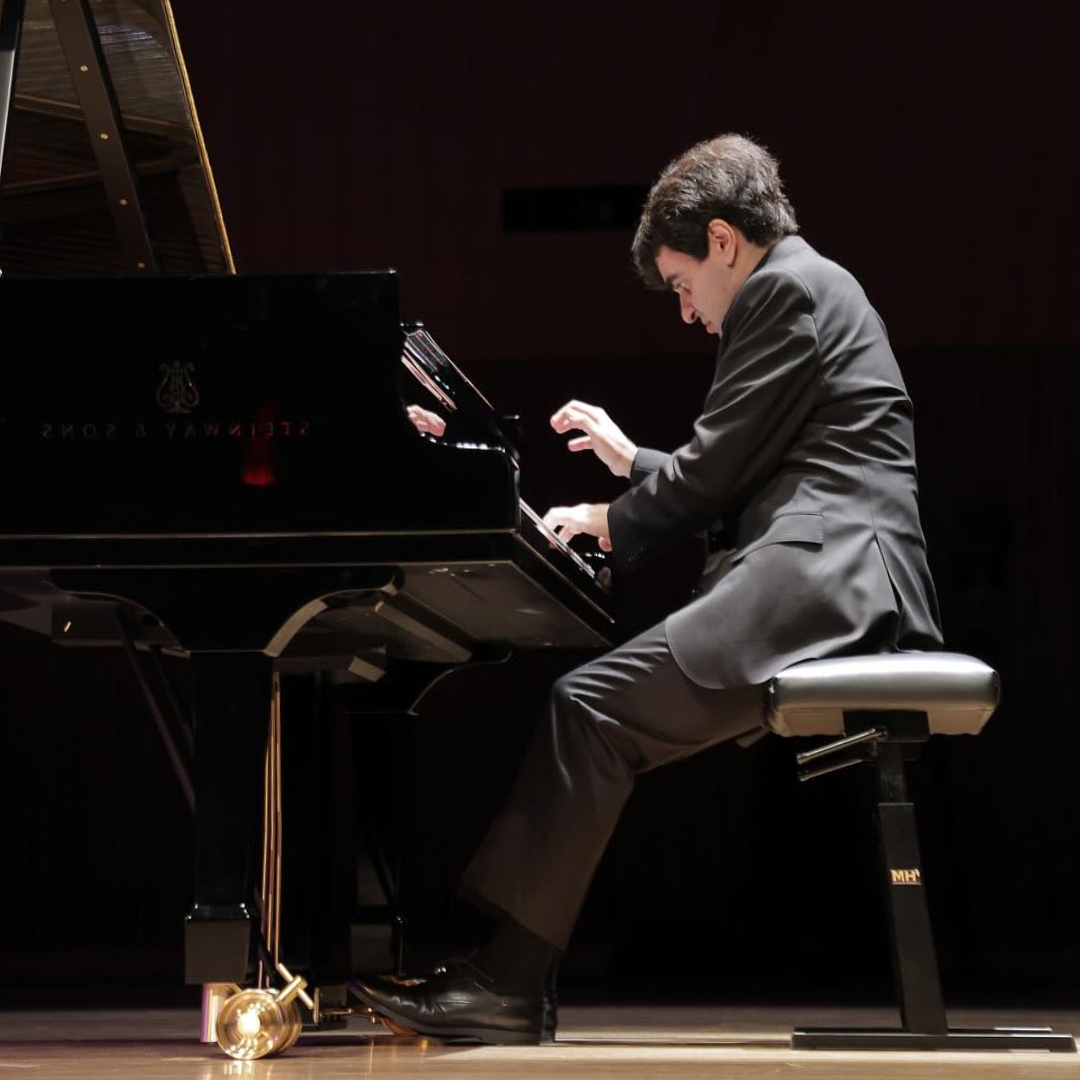
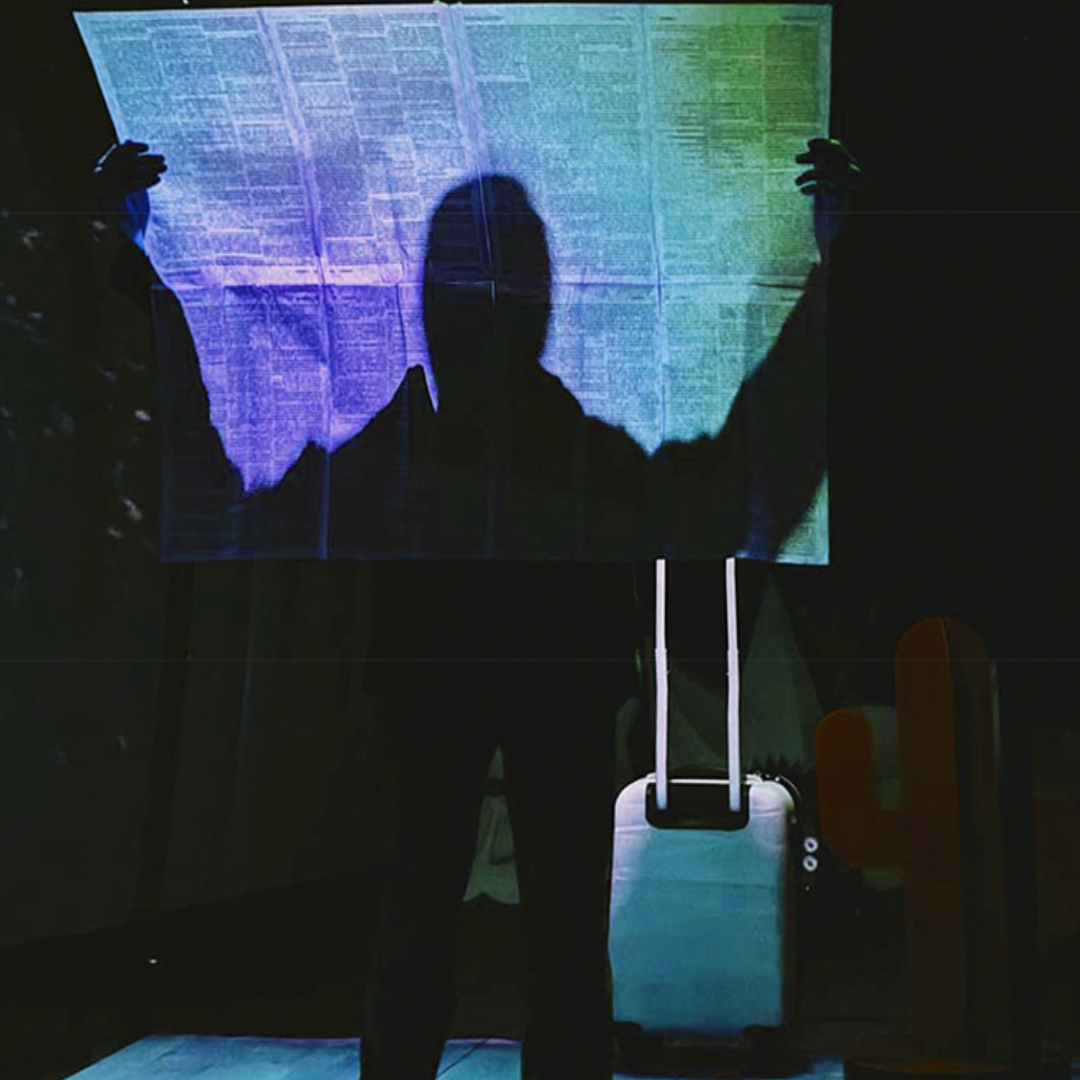
The performance begins before the fiction starts. The Architect – embodied with measured gravity by Giorgi Goderdzishvili – enters from the audience as an ordinary man, still marked by the residues of everyday time. His first shift is not symbolic but physical. Removing casual clothing for a sharp black suit reads less as a costume change and more as crossing into a different temporal discipline – the stringent tempo of human self-control.
Mindia Arabuli’s libretto opens as a philosophical monologue, delivered like a structure built from sound. The Architect contemplates humanity as a species attempting to outrun time, as if duration were a conveyor belt from which escape is impossible. “For all our efforts,” he observes, “man is not a fish.” The line carries an ecological irony: a reminder of the tension between human acceleration and organic endurance.
Inside the elevator, he recites the world’s creation as if tracing civilisation’s sedimentary layers – mammoths, seeds, epidemics, prehistoric birds, divinity, deserts, cities, children’s toys. A catalogue of emergence. Then he presses a button. The cube misfires. Time dislocates.
Sonic Transformation: The Opera as an Acoustic Organism
From the earliest musical murmurs, Gogoberidze’s method becomes unmistakable. The score is not written from themes but from materials. Each sonic stratum behaves like a substance: granular, vaporous, metallic, fibrous, dense. Timbre replaces plot. Texture replaces character. Where convention might use harmony to shape emotion, Cactus uses pressure and density.
The opening sound state is almost vaporous – hushed breaths, faint mechanical rustling, microtonal flecks drifting like dust. The music feels pre-conscious, as though hearing must gradually awaken. Gradually the texture thickens, like moisture gathering in a sealed space.
The clarinet – performed with exquisite restraint by Christopher Manning – enters as an organism rather than an instrument. Its tone feels grown, not played; mineral, vegetal, wavering at the edge of pitch. This is the Cactus: not a protagonist, not a symbol, but a frequency.
Whenever the Architect sings, the clarinet bends in shimmering ripples, as if human voice disturbs the environment’s equilibrium. This acoustic choreography is one of the opera’s most elegant ideas: every human utterance reshapes the ecology of sound.

Later sequences bring heavier matter – clarinet tones blooming into quasi-choral clusters, subterranean drones that feel geologically compressed, noise passages that behave like weather systems: gusts, fractures, tectonic groans. These are not effects; they are states of existence. The opera’s form moves through a metabolic cycle: emergence → condensation → saturation → release. Sound is not accompaniment – sound is the event.
The Attacks: When Time Becomes Somatic
The elevator’s malfunction thrusts the Architect into violent temporal fits – episodes where breath stumbles, movement distorts, perception splinters into shards. Arabuli’s language fractures into syllables, mineral metaphors, proto-myths. The body becomes a terrain; anxiety becomes geology.
Each attack introduces a new mask – extensions of the body that operate like external organs required to survive the pressure of subjective time. Through it all, the Cactus emits its slow, ritual-like resonance. Green light pulses. The air quivers. The clarinet anchors the space like a tuning fork anchoring a vibrating string.
In one attack, the Architect imagines dissolving into ore and returning as oil millions of years later – a temporal metaphor so immense that it erases the line between psychology and geology. In another, silence arrives. The Cactus withdraws. Forced into a void, the Architect produces raw noise in a desperate attempt to provoke a response. Nothing returns. Only when he collapses into openness does the Cactus vibrate again. The lesson is devastating in its quietness: vegetal time cannot be commanded; it can only be joined.

Toward a New Ecology of Opera
CACTUS expands the vocabulary of contemporary opera by treating sound as metabolic matter and space as a resonant chamber. The work relies not on contrasts, but on gradients – thicknesses of sound, intensities of light, shifting densities of presence. It leads the audience into a mode of listening that feels participatory, as if one were attuning to a growing organism.
The accomplishment belongs to the whole constellation: Gogoberidze’s score, an ecosystem of spectral pressure; Arabuli’s libretto, part philosophical treatise, part seismic hallucination; Korkashvili’s direction, which choreographs time rather than bodies; Songhulashvili’s scenography, a cell made spatial; Bekaia’s temporal garments; Arghanashvili’s luminous architecture; Natenadze’s breathing soundscape; Manning’s clarinet – a being; Goderdzishvili’s Architect – a body reassembled in real time.
This opera grows. It metabolizes. It reverberates long after the final silence. At its core, CACTUS reminds us that the most radical music theatre does not aim to entertain or instruct. It aims to reorganize the conditions under which we perceive sound, breath, time, and self. Here, time learns to resonate, the body becomes porous, and the cactus – ancient, quiet, unhurried – discovers its voice.